
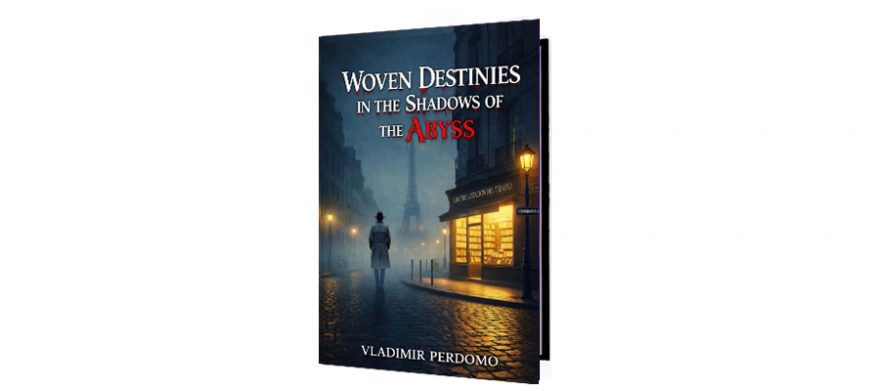
According to the book Woven Destinies in the Shadows of the Abyss written by Vladimir Perdomo, the compass of life has a way of betraying us. It falters without warning, abandoning us in an ocean of memories that do not belong to us—memories we carry as if they were our own.
Harby Prudoud, a journalist worn thin by repetition, seeks refuge in an old bookshop known as The Time Station, hidden along a forgotten street in Madrid. He drifts through European cities like unfinished thoughts. Madrid pulses relentlessly. London hides behind fog. Paris stitches promises he cannot remember making.—hauling behind him a past that resists recall.
In his pocket, a small notebook filled with cryptic addresses sketches a map toward absence, as though someone else had already written his destination. One afternoon,
among dust-heavy shelves, a black-spined book arrests him. It bears no title, only a sequence of engraved initials:
DTSAPCVR—a code that seems to pulse, alive with secrets yet to be decoded.
The author’s name stares back at him like an inverted reflection: Mirdivla Omodrep. An anagram that unsettles the skin. When Harby opens the book, a note slips to the floor:
Go to Paris. The truth you seek is inside you—written in reverse.
In the shadows of Paris, a faceless presence waits, whispering truths Harby is not yet equipped to understand. What he does not suspect is that his mind may already be
woven—thread by thread—by Lorenzo, a psychiatrist who calls himself the Architect, a man convinced he can design the inner lives of the lost. On his board move unstable figures:
Mancini, a criminal persuaded he commands chaos, blind to the illusion sustaining him; Leonor, an enigmatic guide in Paris, a filament stretched taut between loyalty and betrayal.
